Tonada vs Spotify
Spotify says it in its own words: not for your business.
Spotify's support page: "you can't broadcast or play Spotify publicly from a business, such as bars, restaurants, schools, stores, salons". Tonada is built for exactly those rooms, licensed for business, €19.99 per zone, no PRO fees, and a certificate that proves it.
30 days free · No card · Cancel anytime
Playing at Taco Bell, Holmes Place, Convendum, Bunchery, Hawaii Poké and more
The verdict
Spotify at work isn't a grey area; it's a sentence in their terms. And it's everyone's playlist, not your sound.
Choose Tonada if…
- You want music composed in-house: exclusive to your brand on Bespoke, or from Tonada's adaptive library on Premium, adapted to your venue in real time.
- You want to be properly licensed, with one price and no PRO fees from STIM/SAMI, PRS/PPL or GEMA/GVL.
- You want music that plays itself right: no staff phones, no ads, no explicit lyrics at lunchtime, no arguments about whose playlist.
- You want zones, scheduling, a multi-location dashboard and a licensing certificate for the day an inspector walks in.
Choose Spotify if…
- You're at home, in the car, or in your headphones. Spotify is an excellent consumer product; that's the point.
- Your concept needs the actual chart hits by name: then you need a business-licensed service plus society agreements. Compare Tonada vs Soundtrack.
How Spotify and Tonada compare
Last verified:| Feature | Spotify |  |
|---|---|---|
| Licensed for business use | SpotifyNo. Spotify's terms grant permission "to make personal, non-commercial use of the Spotify Service". Support page: "you can't broadcast or play Spotify publicly from a business".1,2 | Yes: Tonada owns every track it plays. |
| Your own sound | SpotifyNo: the same catalogue as every other listener, chosen by whoever holds the phone.8 | Yes: music composed in-house for venues. On Bespoke a dedicated producer composes a catalogue exclusive to your brand; on Premium, Tonada's adaptive library, shaped by your brand profile and adapted in real time. |
| Collecting-society / public-performance fees (STIM & SAMI, PRS & PPL, GEMA & GVL…) Playing recorded music in a business involves two separate licences. (1) The streaming service pays labels and publishers for the right to deliver the music: that is what makes Soundtrack or Mood "licensed for business". (2) The venue itself pays the local collecting societies for playing music to the public. In Europe, layer 2 is not included in the subscription. | SpotifyDue in full from the venue, and paying them doesn't make Spotify allowed. STIM: "Om du använder exempelvis Spotify så ingår inte det tillståndet."3,4 | None: no PRO fees, because Tonada's music isn't registered with any collecting society. Licensing certificate provided. |
| Price per zone, per month | SpotifyA personal subscription, licensed for personal use only. No business plan exists at any price. The venue still owes PRO fees on top, ≈ €30 a month estimated (STIM + SAMI for a 100 m² shop, 2026 tariffs; ≈ €23 with PPL PRS in the UK, ≈ €25 with GEMA in Germany), and remains unlicensed.2,9 | €19.99 (Premium), no PRO fees on top. Bespoke: custom, billed yearly. |
| Proof of licensing for an inspection | SpotifyNone. A Premium receipt is not a licence.1 | Yes: a certificate listing every track and its clearance. "Show it to any inspector." |
| Who sends the invoice | SpotifyThe collecting societies (by estimate, after an inspection) while you remain in breach of Spotify's terms.6,7 | Tonada. Once. |
| Ads | SpotifyFree tier: ads between songs. Premium: none.2 | None. |
| Explicit-lyrics risk | SpotifyA per-account "allow explicit content" toggle, set by whoever owns the phone. Nothing at venue level.8 | None: every track is produced in-house to brand-safe specifications. |
| Zones & multi-location dashboard | SpotifyNo. One account plays on one device at a time.8 | Yes: one dashboard, unlimited locations, zones by location, format or region. |
| Scheduling / dayparting | SpotifyNo.8 | Yes. |
| Adapts in real time (weather, footfall, occupancy, time of day) | SpotifyNo: Spotify's personalisation is about the listener, not the room.8 | Yes. |
| In-store announcements | SpotifyNo.8 | Yes: in-store promotions on both Premium and Bespoke. On Bespoke, announcements and ads are also produced for you. |
| Staff control | SpotifyWhoever holds the phone is the DJ. The playlist leaves when their shift does.8 | Brand profile set centrally; anyone with the app can rate a track while it plays. |
| Offline playback | SpotifyPremium downloads, for personal use.8 | Yes: the apps play offline, and the Tonada Player Box is offline-ready. |
| Hardware | SpotifyAny phone, plus Spotify Connect speakers; the speaker doesn't change the licence.2 | Any phone or tablet, Sonos, or the Tonada Player Box (€15 per month) into any amp or powered speaker. |
| Where the music comes from | SpotifyA consumer catalogue of 100+ million tracks, licensed for personal listening.8 | Composed in-house by Tonada's producers. Exclusive to your brand on Bespoke; from Tonada's adaptive library on Premium. Adapted to your venue in real time. |
30 days free · No card · Cancel anytime
What you're actually risking
The cost of Spotify in a venue isn't the subscription. It's everything the subscription doesn't buy. Playing recorded music to the public means two things have to be licensed: the delivery of the music (which a business-licensed service arranges with labels and publishers, and Spotify doesn't) and the public performance (which the venue pays to the collecting societies). With a personal Spotify account, both are missing, and paying the societies doesn't fix the first one.
A 100 m² shop in Stockholm, open six days a week, playing Spotify
Spotify Premium: a personal subscription that grants no business licence at any price1
STIM, 2026 tariff (≤200 m², 101–312 days): ≈ SEK 2,344 a year, owed regardless9
SAMI, 2026 tariff (51–100 m², 6 days): ≈ SEK 1,692 a year, owed regardless9
If you haven't signed: STIM inspects, gives 14 days to respond, then invoices by estimate; SAMI can collect the fee even without an agreement.67 You still don't have a licence to use Spotify.Tonada Premium: €19.99 × 12 = €239.88 (≈ SEK 2,640) a year. Licensed for business. No PRO fees. Certificate included.
In the UK the equivalent is TheMusicLicence from PPL PRS (from about £235.50 + VAT a year for a small shop10) and the same missing Spotify licence. Society figures are estimates from the published 2026 tariffs.
Spotify says it. STIM says it. SAMI says it.
Spotify's Terms of Use grant you "limited, non-exclusive, revocable permission to make personal, non-commercial use of the Spotify Service".1 Its support page removes any doubt about what that means: "Spotify is only for personal, non-commercial use. This means you can't broadcast or play Spotify publicly from a business, such as bars, restaurants, schools, stores, salons, dance studios, radio stations, etc."2 It then recommends a different company for commercial use.
The collecting societies say the same from their side. STIM: a STIM licence doesn't include the permission to use a consumer service: "Om du använder exempelvis Spotify så ingår inte det tillståndet."3 SAMI and IFPI: private accounts are not for business use.45 And the societies are the ones who act on it: STIM runs inspections, gives you 14 days to respond, then sends an invoice by estimate;6 SAMI can collect the fee even without an agreement.7
Tonada closes both gaps at once. Every track is produced in-house and registered with no society, so Tonada licenses your venue directly and nothing is owed to STIM, SAMI, PRS, PPL or GEMA for it. You get a certificate listing every track and its clearance. If an inspector asks, you hand it over.
The DJ is whoever holds the phone.
Even if the law were on its side, Spotify is the wrong tool for a room full of customers. There is one account, playing on one device, controlled by whoever is holding it. The morning shift's playlist walks out with the morning shift. The free tier plays adverts between songs. Explicit lyrics are governed by a toggle on someone's personal account. There are no zones, so the terrace hears what the bar hears; no scheduling, so Friday night starts whenever someone remembers; no announcements; no dashboard for the manager who runs three sites.
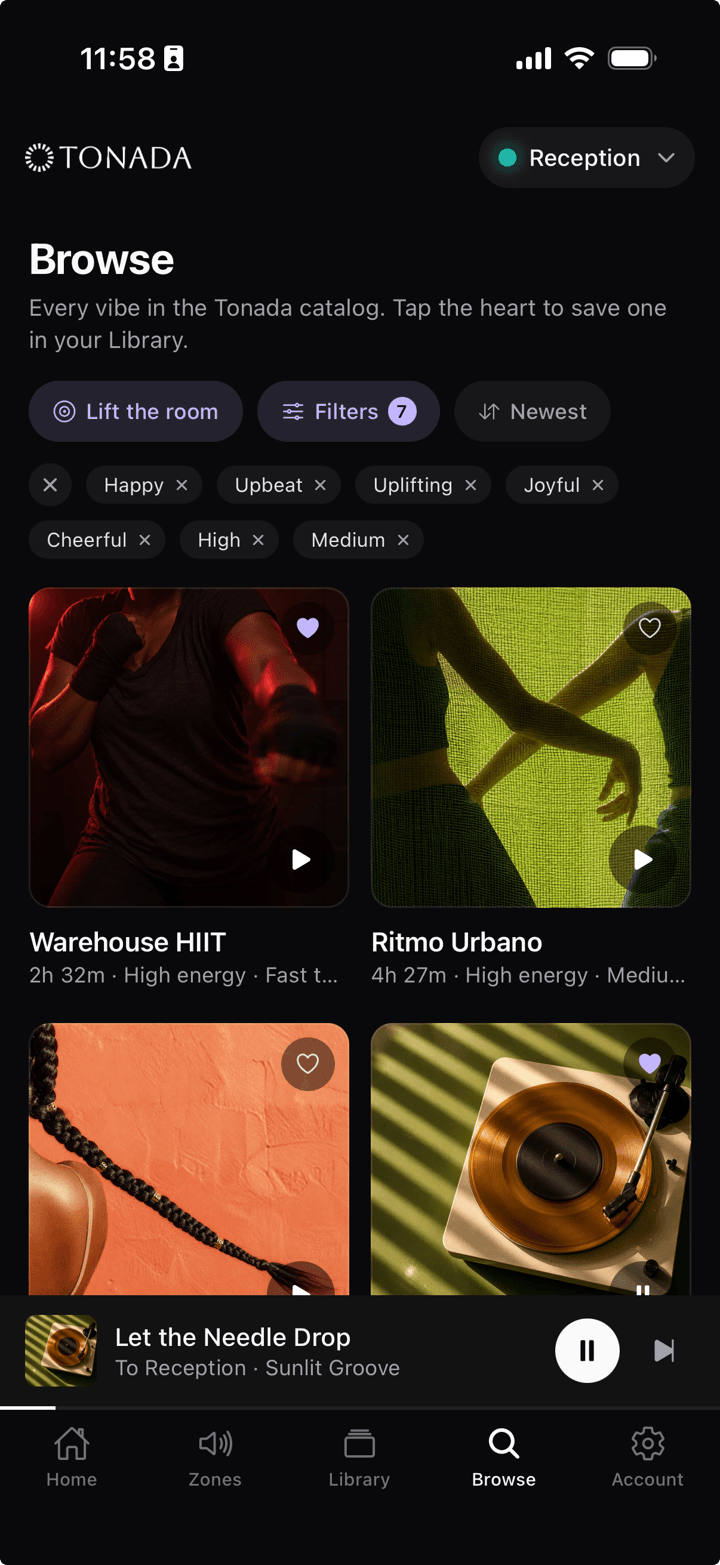
Tonada is the venue's system, not a person's. You describe the space, the vibe and the audience once; the platform adapts energy, tempo and mood to weather, footfall, occupancy and time of day; zones and locations run from one dashboard in their own time zones; staff can thumbs-up or thumbs-down a track from the app without taking over. The music is there when the door opens and it doesn't leave at the end of a shift.
Your customers won't miss the hits. They'll notice the vibe.
The instinct is that customers expect the songs they know. What they actually respond to is tempo, energy and fit, the reasons the classic Milliman study found slower, well-matched music lifted supermarket sales by 38 %. A recognisable song can pull attention toward the song and away from the room; a soundtrack written for the room does the opposite. Tonada's producers compose every track in-house. On Premium you play from Tonada's adaptive library, adapted to your venue in real time; on Bespoke a dedicated producer composes a catalogue that belongs only to your brand. Nobody walks in and hears the same playlist they heard at the last place.
The legal version of Spotify costs more than Spotify.
Spotify's own recommendation for businesses is Soundtrack.2 In Sweden that's SEK 559 per zone per month billed annually for the Essential plan, plus the STIM and SAMI agreements your venue signs itself (around SEK 4,000 a year for a 100 m² shop) plus add-ons if you want to play tracks in your own order.119 Perfectly legal, and roughly four times the price of a personal account before the society fees.
Tonada Premium is €19.99 per zone per month. It is licensed for business, there are no PRO fees, and the price includes the adaptive engine, the apps, Sonos, the dashboard and new music every week. The trial is 30 days with no card and nothing charged automatically. The Player Box, if you need one, is €15 a month.
When Spotify is the better fit
- At home, in the car, in your headphones. It's an excellent consumer product, and that is exactly what its licence covers.
- Your concept lives on specific chart hits and artists by name: then you need a business-licensed service with a commercial catalogue and society agreements on top. Compare Tonada vs Soundtrack before you decide.
Switch in three steps
- Start the 30-day Tonada trial, no card, nothing charged automatically.
- Describe your space, vibe and audience; install the app on the venue tablet, connect Sonos, or plug a Tonada Player Box into your amp.
- Take the personal Spotify account home, where its licence applies.
Frequently asked questions
It breaches Spotify's terms, which allow personal, non-commercial use only, and playing recorded music to the public requires licences from your collecting societies (in Sweden STIM and SAMI; in the UK PPL PRS; in Germany GEMA and GVL). Those licences don't cover Spotify either. In practice the consequence comes from the societies, not from Spotify: an inspection, a deadline to respond, and an invoice by estimate.
No. STIM's FAQ answers this directly: a STIM licence covers the public performance, but the permission to use a consumer streaming service in a business isn't included: "om du använder exempelvis Spotify så ingår inte det tillståndet". SAMI and IFPI say the same about private accounts.
No. Spotify sells no business plan. "Spotify Business" was the launch name, in 2014, of what is now Soundtrack (a separate company Spotify invested in) and Spotify's support page points businesses there. Note that outside the US and Canada, Soundtrack customers still pay their own society fees; see Tonada vs Soundtrack.
The speaker doesn't change the licence. Spotify's terms attach to the account, and the public performance is the venue's responsibility regardless of the device.
No. Tonada plays music composed in-house by its own producers: from Tonada's adaptive library on Premium, or a catalogue exclusive to your brand on Bespoke, adapted to your venue in real time. That's why Tonada is licensed for business at one price with no PRO fees, and why your venue doesn't sound like everyone else's playlist.
Spotify's own recommendation, Soundtrack, costs SEK 559 per zone per month in Sweden billed annually, plus the STIM and SAMI fees your venue pays itself, roughly SEK 4,000 a year for a 100 m² shop. Tonada Premium is €19.99 per zone per month with no PRO fees.
You show the Tonada licensing certificate, which lists every track and confirms none of it is registered with any society. Societies can only license repertoire they administer. Keep other sources (radio, TV sound, personal streaming accounts) off, or their fees apply to the whole venue.
Yes, without owning it. Anyone with the Tonada app can thumbs-up or thumbs-down a track while it plays and the platform learns; the brand profile stays under your control, so the sound doesn't change when the shift does.
Licensed for business. No PRO fees. Music composed in-house for your brand.
Start your 30-day free trial, no card required. Running a chain? Talk to sales about Bespoke.
30 days free · No card · Cancel anytime
Sources & verification
Every competitor claim above links to one of these. Last verified 12 Sept 2026.
- 1.Spotify Terms of Use, §3 "Your Use of the Spotify Service" (last updated 4 Sep 2026): "personal, non-commercial use" (seen 2026-09-12)
- 2.Spotify Support: "Spotify for public or commercial use" (recommends Soundtrack) (seen 2026-09-12)
- 3.STIM FAQ: Do I need a STIM licence when I pay for a streaming service in my business? (seen 2026-09-12)
- 4.SAMI FAQ: music in business ("Kan jag spela Spotify om jag har musikavtal?"); IFPI Sverige: musiktjänster (seen 2026-09-12)
- 5.IFPI Sverige: Musiktjänster (private Spotify subscriptions not permitted in business) (seen 2026-09-12)
- 6.STIM FAQ: Gör Stim musikkontroller? (inspections, 14 days, schablonfaktura) (seen 2026-09-12)
- 7.SAMI: price lists (collection without agreement; fee applies to streaming, radio and TV alike); SAMI 2026 butik PDF (radio/TV priced higher) (seen 2026-09-12)
- 8.Spotify: product pages and help (Premium plans, device limits, explicit-content setting) (seen 2026-09-12)
- 9.STIM 2026 tariff: Musik i kund- och besöksytor; SAMI 2026 price list: butik (seen 2026-09-12)
- 10.PPL PRS: How much does TheMusicLicence cost? (Feb 2026 examples) (seen 2026-09-12)
- 11.Soundtrack: Plans & Pricing (Sweden pricing shown) (seen 2026-09-12)
- 12.TechCrunch: Spotify Business launch (May 2014), the product now called Soundtrack (seen 2026-09-12)
Also compare: Tonada vs Soundtrack · Tonada vs Apple Music · All comparisons
Comparison information was collected from publicly available sources (competitor websites, help centres, terms of service, and review platforms) and last verified on 12 Sept 2026. Prices and features change; check the provider's site for the current version. Soundtrack, Mood Media, Royal Streaming, Spotify, Apple Music and all other names are trademarks of their respective owners. Tonada is not affiliated with, endorsed by, or sponsored by any of them. Spotted an error? Email hello@tonada.com and we'll fix it.